
By Emmanuel Edudzie
Executive Director, YOTA
Over more than two decades of working with young people in Ghana and across Africa, I have been struck less by the differences in their ambitions than by the unequal conditions under which they are expected to realise them.
Young people want relevant education, dignified work, economic security, meaningful participation and a sustainable future. They want the freedom to create, contribute and build lives of purpose. These aspirations cross national, social and economic boundaries.
What varies most is not aspiration, but access.
This is why the theme of International Youth Day 2026, “Different Contexts, Common Aspirations”, is so timely. It reminds us that, although young people live in markedly different circumstances, their futures are increasingly shaped by interconnected challenges. It also calls us to recognise that sustainable development and youth development are shared responsibilities.
Shared challenges, unequal starting points
Education, employment, climate change, digital inclusion and mental well-being are often discussed as separate youth issues. In reality, they interact continuously.
A young person leaving an under-resourced school may enter a labour market in which qualifications do not translate into employment. Without affordable internet access, professional networks or financial capital, that young person may also be excluded from digital learning, entrepreneurship and emerging industries. Climate shocks can further disrupt livelihoods, intensify displacement and deepen economic insecurity. The resulting pressure affects not only income, but also confidence, dignity and mental well-being.
Evidence from YOTA’s work illustrates these connections. The Ghana Youth Barometer 2024, based on a nationwide survey of 1,940 young people, found that 88.1 per cent regarded limited financial resources as a barrier to education. Almost seven in ten respondents identified a mismatch between the educational curriculum and labour-market demands as a major concern. Although many young people aspired to self-employment, inadequate financial and social capital stood in their way.
More recently, the Ghana country study on technical and vocational education and training, co-launched by YOTA and the Ghana TVET Service, highlighted substantial weaknesses in internet connectivity, modern equipment, curriculum relevance and preparation for fields such as artificial intelligence, robotics and digital entrepreneurship.
These are not failures of ambition. They are signs that the systems surrounding young people are not keeping pace with their aspirations or with economic change.
Young people are already building answers
Despite these constraints, young people across Africa are not waiting passively for solutions. They are developing enterprises, organising communities, advancing climate action, using technology creatively and demanding accountability from public institutions.
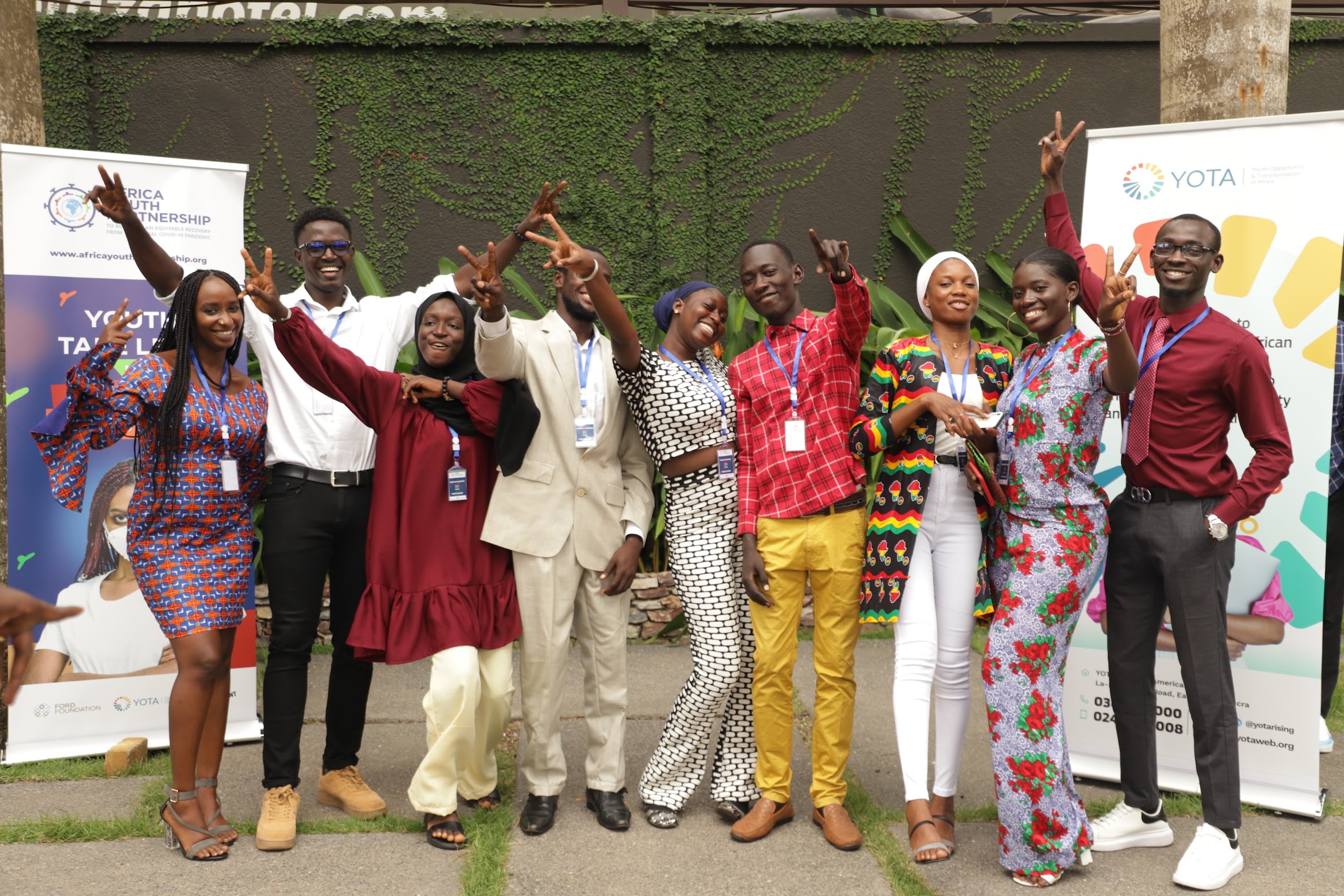
Through the Africa Youth Partnership, YOTA and its partners established Youth Task Teams across ten African countries. These teams gathered evidence, examined public policy responses and translated young people’s experiences into policy briefs, petitions, statements and advocacy initiatives. The Partnership also convened more than 1,300 young innovators to develop approximately 1,000 ideas addressing challenges in education, health, vaccine equity and other areas of Africa’s recovery.
At YOTA’s Skills Hub, we see the same energy every day. Young people arrive with business ideas, career ambitions and a desire to acquire practical capabilities. By combining entrepreneurship support, digital and job-search skills, mentoring, career guidance, professional networks and accessible infrastructure, the Hub helps convert that determination into viable pathways.
These experiences have taught us something important: young people do not lack ideas, initiative or the desire to contribute. What they frequently lack are enabling institutions, sustained investment, trusted networks and equitable access to opportunity.
We must therefore be careful about how we celebrate youth resilience and innovation. Youth innovation is evidence of capacity, not permission for institutions to withdraw from their responsibilities.
Young people should not have to overcome avoidable institutional failures simply to demonstrate that they are resilient.
Solidarity must become practical
Global solidarity must mean more than statements of support or invitations to conferences. It must be visible in how resources are distributed, whose knowledge is respected and who has the power to shape decisions.
For governments, this means reforming education-to-work systems so that learning leads to recognised capabilities, professional progression, enterprise and decent employment. It means investing in digital connectivity, green and technical skills, workplace experience and career services. It also means creating formal mechanisms through which young people can influence policies, public expenditure and implementation.
For businesses, solidarity means opening credible pathways into the economy through apprenticeships, professional development, supply-chain opportunities, decent work and investment in youth-led enterprises. Young people cannot prepare for the future of work without access to the workplaces, technologies and professional relationships through which that future is being created.
For international development partners, solidarity requires sustained investment in locally rooted African and youth-led institutions. Short funding cycles and narrowly defined projects may produce activities, but they rarely provide the stability required to build institutions, strengthen systems or take proven solutions to scale. Local organisations must be treated as strategic partners and knowledge producers, not merely as channels for implementing priorities determined elsewhere.
Civil society and youth organisations also have responsibilities. We must collaborate across borders, share evidence and learning, strengthen our governance and remain accountable to the young people in whose name we speak. Representation must be inclusive of young women, rural youth, persons with disabilities and young people working in informal economies or living in fragile communities.
Most importantly, we must change how progress is measured. Attendance at a training programme is not the same as improved capability. Participation in a consultation is not the same as influence. Funding a youth project is not the same as transforming the systems that constrain young people.
We should ask whether young people have gained sustainable livelihoods, recognised skills, stronger institutions, greater agency and a genuine role in shaping their societies.
From common aspirations to shared progress
International Youth Day is rightly a moment to celebrate the ingenuity, courage and leadership of young people. But celebration must be accompanied by responsibility.
The challenges facing young people are connected across borders. So too must be our responses. Governments, businesses, civil society organisations, educational institutions and international partners must work with young people to build systems capable of translating aspiration into opportunity.
We should listen to young people, but we must go further. We must invest in them, share power with them and reform the institutions that shape their transitions into adulthood and work.
Different contexts need not become unequal destinies. If we act in genuine solidarity with young people, not merely for them, we can build societies worthy of their common aspirations.
The ambition, creativity and leadership already exist. Our shared responsibility is to ensure that opportunity does too.