
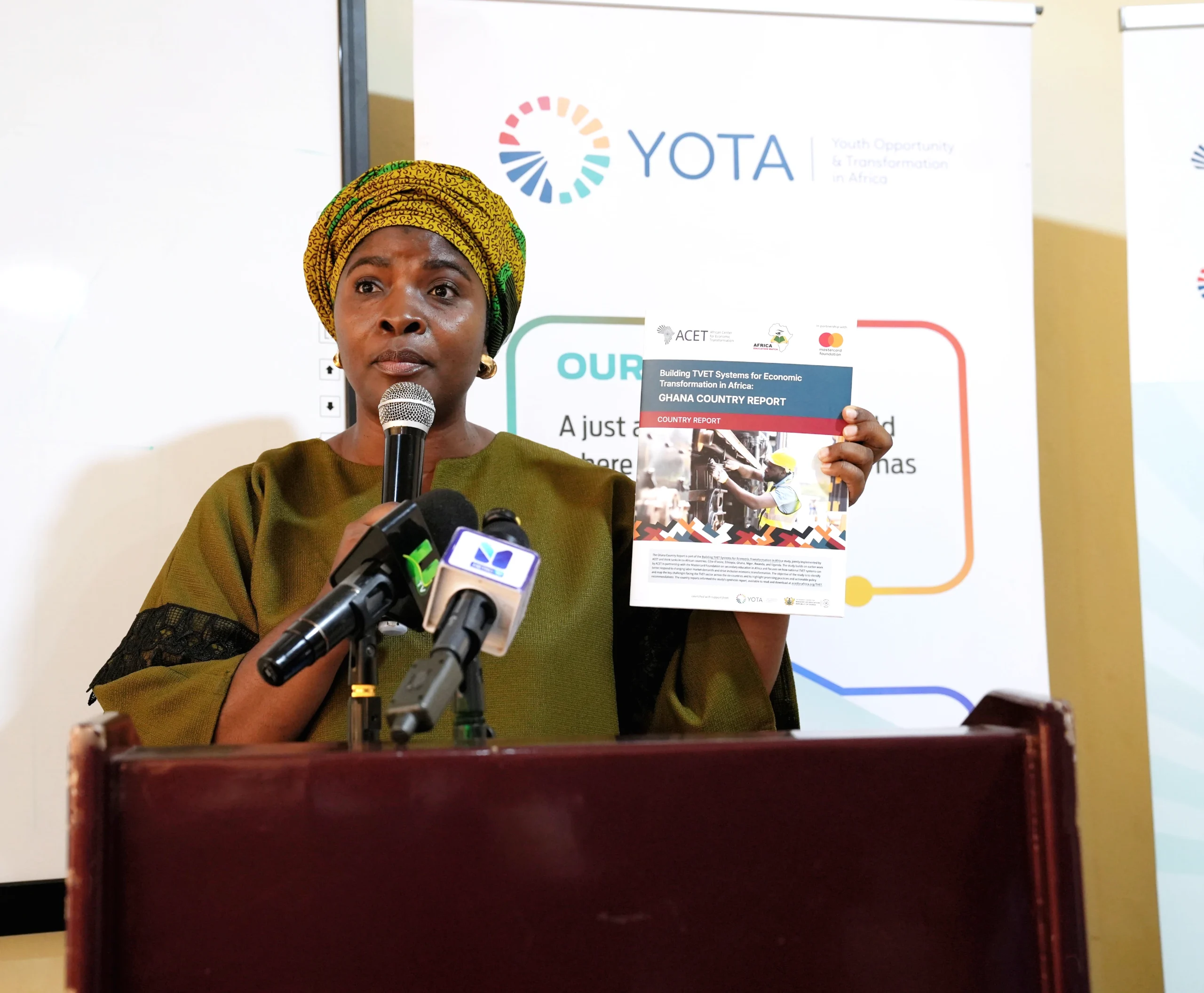
Youth Opportunity and Transformation in Africa (YOTA), in collaboration with the Ghana TVET Service and partners, has co-launched the Ghana Country Report on Building TVET Systems for Economic Transformation in Africa, revealing deep structural weaknesses in Ghana’s technical and vocational education and training (TVET) system and calling for urgent reforms.
The report, developed by African Center for Economic Transformation and Africa Education Watch, is part of a six-country study assessing how African TVET systems are responding to the demands of the Fourth Industrial Revolution.
Presenting the report, Mr. Kofi Asare, Executive Director of Africa Education Watch, delivered a detailed analysis of the findings, highlighting critical gaps in infrastructure, funding, and skills alignment that continue to constrain the effectiveness of Ghana’s TVET system. He stressed the urgency of aligning training with labour market needs and equipping learners with future-ready competencies.
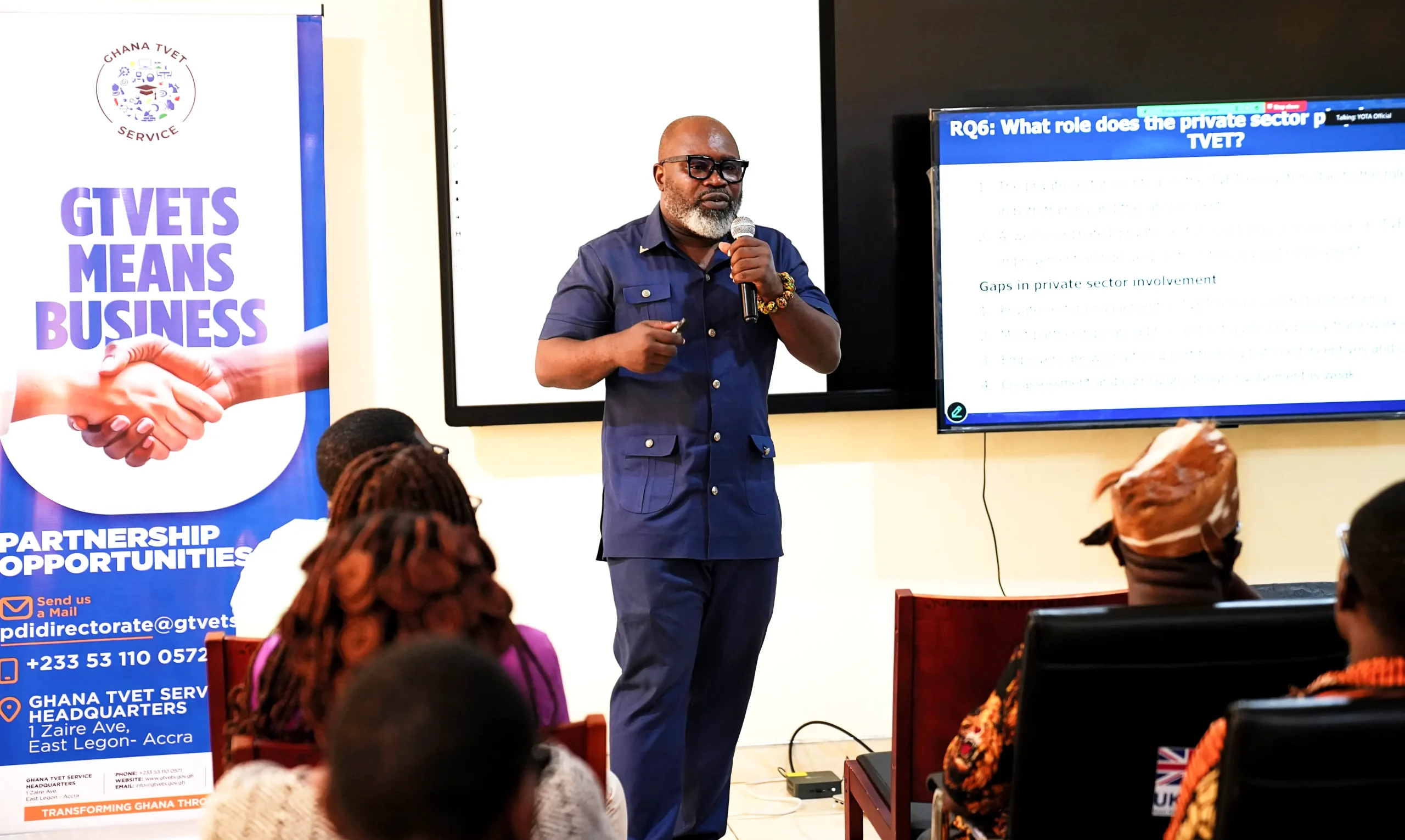
Kofi Asare, Executive Director of Africa Education Watch
The findings paint a stark picture of the sector. Only 10 out of 261 TVET institutions, representing less than 4%, have access to internet connectivity, exposing a severe digital divide. At the same time, 75% of TVET curricula are outdated, while funding for TVET remains below 2% of the national education budget, far short of the recommended 5%. Female participation also remains low, with just 26% enrolment in TVET programmes.
According to the report, 47% of stakeholders identify inadequate financing as the biggest challenge, followed by limited practical training and outdated equipment at 28% each, poor digital infrastructure at 26%, and weak STEM integration at 23%. These constraints continue to weaken the link between training and employment outcomes.
Mr. Asare further highlighted the growing mismatch between skills training and emerging industry demands, noting that advanced competencies such as artificial intelligence, robotics, and digital entrepreneurship are largely absent from current programmes. Data from the report shows that 97% of institutions do not offer training in AI-related skills, reinforcing concerns about Ghana’s readiness for the digital economy.
The broader implications for the economy are significant. With 70% of Ghana’s population under the age of 35 and youth unemployment estimated at 14.7%, stakeholders emphasised that strengthening TVET is critical to addressing unemployment and driving productivity.
Delivering the keynote address, Dr. Eric Kofi Adzroe, the Director General of the Ghana TVET Service, reaffirmed government’s commitment to reform, announcing a newly approved five-year strategic plan aimed at improving training delivery, expanding workplace experience learning, and strengthening industry partnerships.

Dr. Eric Kofi Adzroe, the Director General of the Ghana TVET Service
Speaking on behalf of the African Center for Economic Transformation (ACET), Mavis Owusu Gyamfi, President and CEO of ACET, underscored that Ghana’s ability to compete in a rapidly evolving global economy will depend on how effectively it equips its workforce with relevant, future-ready skills, calling for increased investment and stronger collaboration across sectors.

Mavis Owusu Gyamfi, President and CEO of ACET
The co-launch brought together policymakers, industry leaders, educators, and young people, who echoed concerns about limited access to modern equipment, uneven training quality, and barriers to workplace learning, while also highlighting the need for stronger incentives to encourage private sector participation.
The report concludes that transforming Ghana’s TVET system will require sustained commitment to increasing funding, modernising curricula, expanding digital and green skills training, and promoting inclusive access, particularly for women and marginalised groups.






75% of TVET curricula are outdated,
Could this be true?
What about the CBTRA curricular?
Hi Robert, thank you for raising this important point. The 75% figure is drawn from the findings of the Building TVET Systems for Economic Transformation in Africa – Ghana Country Report, based on stakeholder consultations and evidence gathered during the study.
You’re right to mention CBT/CBTRA. The report recognizes the significant progress Ghana has made with Competency-Based Training and Assessment (CBT/CBTRA). However, the finding reflects broader concerns that many curricula across the TVET system still require regular review and stronger alignment with evolving industry needs, emerging technologies, and the changing labour market.
In other words, it’s not a criticism of CBTRA itself, but a call for continuous curriculum updates to ensure TVET graduates remain competitive and job-ready. We encourage you to read the full report for the methodology and detailed findings. We also welcome further discussion on this important issue.